The NVIDIA Blog

NVIDIA, Partners Break Out in Embedded World
Posted: 27 Feb 2015 11:07 AM PST
Embedded computing products are everywhere. In drones whirring overhead. On wrists tracking heartbeats and incoming tweets. On walls regulating the temperature of homes.
These devices are useful in their own ways, but they aren't particularly powerful.
At NVIDIA, we're focused on the tough challenges. And this week at Embedded World, just outside Munich in Nuremburg, Germany, we showcased a bevy of partners who are using our tools where space, weight and power constraints are the norm.
By unlocking the power of the GPU for embedded applications, we're helping developers bring computer vision to drones, artificial intelligence to robots, and a host of other sophisticated applications that can sense, interpret and respond to the world around us.
We married our embedded processors to a platform that puts incredible power and power efficiency at the fingertips of developers.
In the case of our Jetson TK1 development kit, we offer the same GPU architecture that powers some of the world's fastest supercomputers. This provides a fully functional accelerated computing platform to quickly develop and deploy compute-intensive systems for computer vision, robotics, medicine and more.
GE's new Mini COM Express module uses the Tegra K1 processor to deliver 326 GFLOPS of performance—while consuming less than 10 watts of power. Compact in size and made rugged for harsh environments, the module targets commercial, aerospace and military applications for everything from industrial process automation to medical imaging to sensor processing.
Concurrent Technologies' new AdvancedMC module is fitted with up to four Tegra K1 processors for 1.3 TFLOPS of performance on a board that roughly takes up the area of a postcard. It's designed for applications such as transcoding, image analysis and encryption, where server-based equipment is otherwise impractical to use.
SECO's new COM-Express Type 6 compact module is based on the Tegra K1 mobile processor. And Toradex showcased the world's first preview of a module supporting Windows 10, using an NVIDIA Tegra 3 processor.
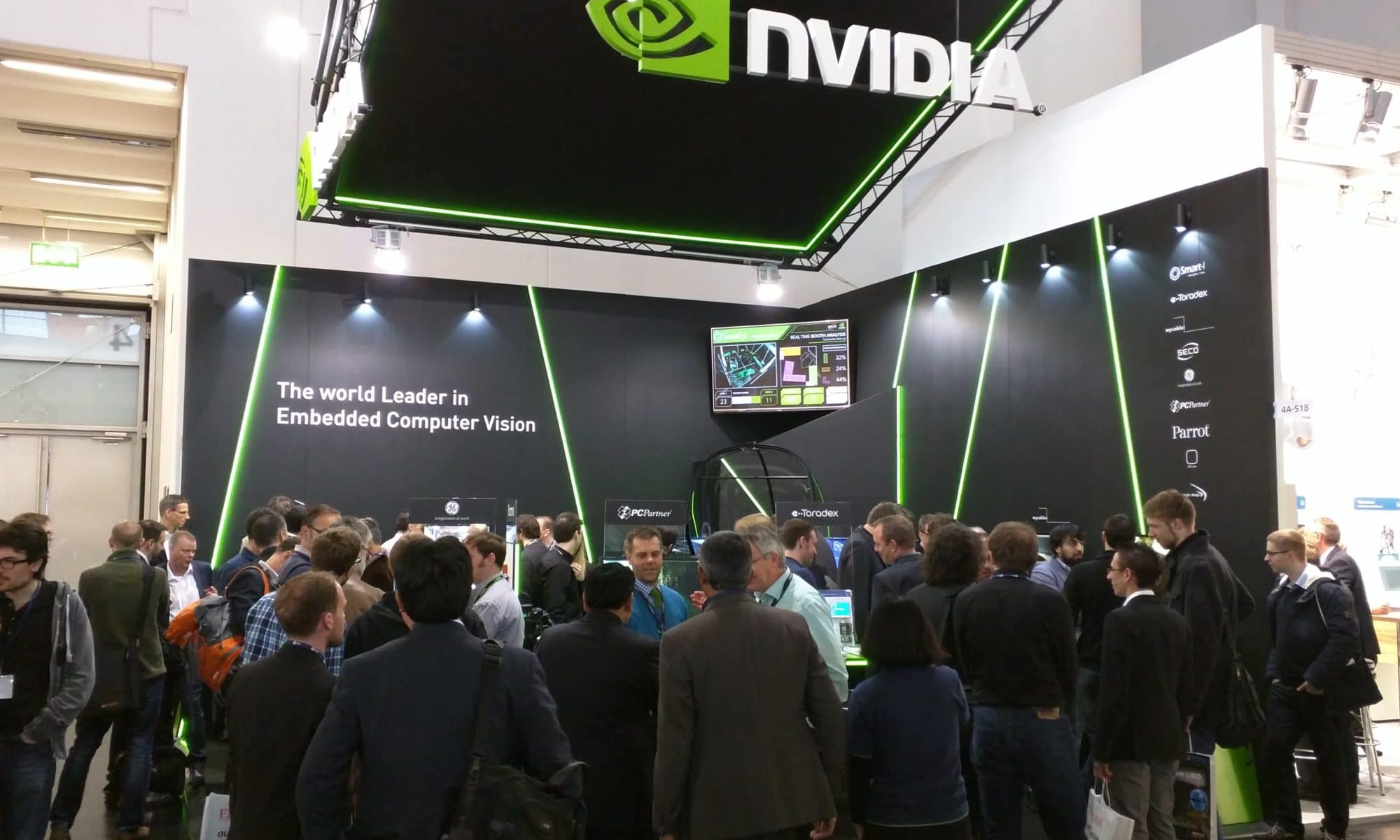 Pack’em in: NVIDIA’s booth showcased embedded computing offerings from a range of partners, and was packed all week.
 Our booth included a real-time analysis of the distribution of people visiting us, with SECO and SmartEye. Parrot showed a computer vision tech demo that models in fine detail the environment it observes.
Find out more about our latest offerings in embedded computing here.
The post NVIDIA, Partners Break Out in Embedded World appeared first on The Official NVIDIA Blog.


GTC’s Got Game: Learn How NBA, NHL Arenas Use Floors as Giant Displays
Posted: 26 Feb 2015 06:49 PM PST
Don't blink. Whether a fast break in basketball or a 100 mph slap shot in hockey, indoor sports are all about speed.
Fans know not to take their eyes off the action or they could miss something amazing.
That's why pro sports teams are installing a new generation of NVIDIA GPU-powered projection systems. They put stunning 3D images right onto the field of play.
At our GPU Technology Conference this March, you can attend nearly a dozen sessions covering all aspects of large-scale displays. Register for the conference now to secure your spot.
 All rise for the national anthem, at Montreal’s Bell Centre.
 Immersive, Full-Court Projections
Whether in an arena or on a stage, lifelike digital projections are becoming a staple of live sporting events. Many of these systems rely on coolux Media Systems' Pandora's Box, which handles 3D projection mapping, real-time compositing and tracking, blending and warping.
Live crowds will be viewing these systems, so they have to be reliable. That's why coolux relies on NVIDIA GPUs to handle real-time video manipulation.
Quince Imaging—known for tackling challenging image-projection projects—began working with the Cleveland Cavaliers last year. The goal: create an immersive, full-court projection as part of the team's jersey retirement ceremony for two-time All-Star center Zydrunas Ilgauskas.
 Cleveland Cavaliers go big to retire jersey of big man Zydrunas Ilgauskas.
 The event was a hit, getting more than 2 million views online. Now cutting-edge on-court visuals will be part of all Cavs home games. The Sacramento Kings, Philadelphia 76ers and other teams are following suit.
Basketball fans love it. Ice hockey fans are getting a taste of the technology as well.
Montreal's Bell Centre turned the ice that's home to the NHL's Montreal Canadiens into the world's coolest high-definition display.
For the hockey season, the Bell Centre called on local technology developer IMMERSIVE Design Studios to create something that would make jaws drop.
Working with audio-video systems integrator Solotech, IMMERSIVE created a cutting-edge system. Called CANVAS, it uses NVIDIA GPUs to project 6K video right onto the ice.
Thanks to IMMERSIVE, the Bell Centre's stunning hockey pre-game show was the first to be televised live.
 Larger than life, at Bell Centre in Montreal.
 And the folks who run the arena haven't stopped there. They're planning to expand from pre-game shows into feature-length projections.
These large-format, high-resolution displays aren't just for sporting events. You'll find them everywhere from corporate conference rooms to supercomputing facilities.
To learn more, attend GTC this March. Among the sessions on large-scale displays will be talks focused on learning how NVIDIA Quadro pro graphics cards make it easier to install giant displays.
IMMERSIVE will be at GTC. As will experts from organizations like Boeing, Oak Ridge National Laboratory, Brown University and, of course, NVIDIA. Our Senior Solutions Architect Doug Trail will be giving a tutorial on how to "See the Big Picture."
For more, check out the Large Scale & Multi-Display Visualization track on the GTC website. And register to attend today.
The post GTC's Got Game: Learn How NBA, NHL Arenas Use Floors as Giant Displays appeared first on The Official NVIDIA Blog.


You are subscribed to email updates from The Official NVIDIA Blog
To stop receiving these emails, you may unsubscribe now.
Email delivery powered by Google
Google Inc., 1600 Amphitheatre Parkway, Mountain View, CA 94043, United States