The NVIDIA Blog |
- How GPUs Keep Pace with Shape-Shifting Viruses
- New GeForce GTX 960M, 950M Notebook GPUs: Lightweight Design, Heavyweight Performance
- Audi Offers Taste of Tegra-Powered Future at Geneva Motor Show
- Get Real: GTC to Showcase Graphics Virtualization Experts
|
Posted: 12 Mar 2015 11:01 AM PDT
Editor's note: This is the last of a series of five posts profiling finalists for NVIDIA's 2015 Global Impact Award, which provides $150,000 to researchers using NVIDIA technology for groundbreaking work that addresses social, humanitarian and environmental problems.
Viruses are a threat to human health on a global scale. They mutate as fast as the vaccines and drugs designed to combat them. The ability of the human immunodeficiency virus, or HIV, to adapt to antiviral drugs and treatments means new compounds need to be developed continuously.  To keep pace with this fast-changing virus and others like it, scientists at the University of Illinois at Urbana-Champaign looked beyond the microscope and turned to supercomputers to pull data from multiple sources for analysis. Examining how the complex communication game between the cell and the virus works could lead to therapies that disrupt these interactions. "We're using computers at the same time as working on experiments – it's a close collaboration between people taking data and using computational means," Klaus Schulten, professor of physics at the University of Illinois at Urbana-Champaign. "Computers are also our research instruments." The research has placed the university among five finalists for NVIDIA's 2015 Global Impact Award. We award our annual grant of $150,000 to researchers using NVIDIA technology for groundbreaking work addressing social, humanitarian and environmental problems. Chemical Warfare Scientists harnessing GPU-powered supercomputers combine new methodologies and algorithms for molecular simulation, visualization and analysis, which can simulate complex human viruses such as HIV in full atomic detail. The large size of the HIV capsid, or shell, combined with its irregular shape poses huge challenges in resolving its chemical structure. "The communication of the capsid's chemistry and the chemistry of the infected cell is very complex," Schulten said. "There are 60 million atoms of the physiological fluids around the capsid in addition to the capsid's own 4 million atoms. Their simulation requires very powerful algorithms. The only way we could do this was with supercomputers." For HIV to infect a cell, the virus must enter the cell and communicate chemically while evading attack by the cell's defense mechanisms. These defense systems want to break the HIV capsid apart before it causes harm and inserts the viral genetic message into the cell's genome. "There's chemical warfare going on, and that's what we need to understand to develop new drugs," Schulten said. "Simulation of viral infections is very health-relevant if you think of flu season, the measles outbreak and Ebola," he said. "We have to find vaccinations and treatments, and for that to happen, we need to understand how things get infected because a virus is very smart." 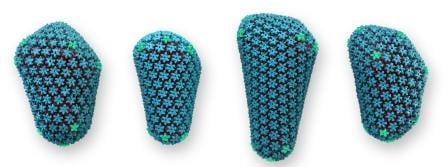 Communication Game For assessing the dynamics of the HIV capsid in the cell, scientists apply massive computing power that allows them to examine the chemistry of cell-virus capsid communication occurring during the infection cycle. Work by the researchers led to the use of GPUs in the fastest computers in the world, including Titan, at Oak Ridge National Laboratory, and Blue Waters, at the National Center for Supercomputing Applications at the University of Illinois. "We needed our computation accelerated by GPUs, which made them 3X faster," Schulten said. "We're intensely working on employing also the next generation of GPUs so we can apply our simulations to further types of viruses infecting the cell." Processing data for the complex structures of cells would have taken a powerful single-processor computer almost two decades, and "now it takes 20 minutes," said Schulten. Schulten and his team are now preparing for the next steps in technology, with computers that will become available in 2018. The post How GPUs Keep Pace with Shape-Shifting Viruses appeared first on The Official NVIDIA Blog.    |
|
Posted: 12 Mar 2015 06:00 AM PDT
We're filling out today our awesome GTX 900M lineup by introducing the GeForce GTX 960M and 950M, which deliver never-before-seen levels of gaming performance wrapped inside sleek notebook designs.
 They're available immediately, so gamers today have more thin and light gaming notebooks to choose from than ever before. In fact, many have now joined the "size does matter" club, and have notebooks less than one-inch thick.  So, if you've been itching to take your gaming on the go with a portable notebook design, now's your chance. Of course, gamers know our relationship with developers, and our work to tune our drivers to work with the latest games. And they know we're invariably the first to introduce new features that enhance gaming, including:
 To add another level of quality, NVIDIA makes sure our game-ready drivers are WHQL (Windows Hardware Qualification)-certified. That means they're tested on over 500 platforms for quality and stability. The only question now: which of these will you choose?  You'll find the new GeForce GTX 960M and 950M from your favorite notebook brand in all shapes and sizes, including those from Asus, Alienware, MSI, Razer, HP, Lenovo, Acer, Clevo, Gigabyte and more. So, what are you waiting for? Game on. The post New GeForce GTX 960M, 950M Notebook GPUs: Lightweight Design, Heavyweight Performance appeared first on The Official NVIDIA Blog.   |
|
Posted: 11 Mar 2015 06:05 PM PDT
New kinds of materials. New kinds of power trains. New kinds of digital displays.
Bring it all together and you've got the 2015 Geneva Motor Show, where we're celebrating another round of incredible new vehicle introductions, powered by NVIDIA. Audi kicked off this week’s show with a range of futuristic new vehicles. They include the R8 e-tron supercar, the Q7 SUV, and the stunning new Prologue Avant concept. R8 Is Enough For the first time, Audi's R8 sports coupe will be available as a pure electric vehicle. To keep this battery car light, Audi engineers used even more carbon fiber in the R8 e-tron's construction compared to the standard version of the car. This is a design that will go far. Literally. The car boasts a 92-kWh capacity battery with a range of about 280 miles.  That big battery also translates into big performance. The R8 e-tron delivers 678 pound-feet of torque from dual motors (rated at 456 horsepower). The result: the R8 e-tron accelerates from 0 to 100 km/h (62.1 mph) in 3.9 seconds. Top speed? An electronically restricted 250 km/h (155.3 mph). And this sleek new design features a virtual cockpit powered by NVIDIA Tegra. A Digital Savvy SUV Tegra also helps drivers and passengers take command of Audi's new flagship SUV, the Q7, which will sport as many as four NVIDIA Tegra processors. You’ll find us powering the Q7’s virtual cockpit with rich rendered graphics on a 12.3-inch TFT display. We're also in the Audi Connect system in the center stack, with an all-in-touch control unit complete with smartphone integration with Google Android Auto and Apple CarPlay. Plus, you can add two Audi Tablets for rear seat entertainment.  These are no ordinary tablets. Audi's Tegra 4-powered Android tablets are integrated into the Q7's vehicle systems. And they're connected to the infotainment system so passengers get access to the radio, media, navigation and car functions. Prologue of What's to Come Giving an even further glimpse into the future: a new Prologue Audi concept car. It's a future that's not short on pixels. The elegant design blends in with a game-changing new display and control concept enabling digital interaction between the driver and passengers.  Across its full width, the front of the dashboard is designed as a display surface which integrates three touch displays. Aluminum frames surround the two driver-facing displays on either side of the steering wheel. The left controls the assist functions; the right is for multimedia management. The front passenger faces a widescreen display integrated into the full surface of the instrument panel. With a swiping movement, the front passenger can send media content such as music playlists to the right driver display. Or the passenger can send navigation data to the Audi virtual cockpit behind the steering wheel. On the console of the center tunnel – between the driver and the passenger – there's another display for text entry, air conditioning and infotainment designed for the driver. It consists primarily of a thin, bendable organic light emitting diode, or OLED, display that's positioned just within reach. The post Audi Offers Taste of Tegra-Powered Future at Geneva Motor Show appeared first on The Official NVIDIA Blog.   |
|
Posted: 11 Mar 2015 12:21 PM PDT
Run a business? Have users spread across offices or working remotely? Want to share graphics apps with them virtually? Then get yourself to our GPU Technology Conference, because enterprise graphics virtualization is about to get real.
With participation by some of the biggest names in manufacturing, technology and engineering, the show's Graphics Virtualization track is one you won't want to miss. It includes some 50 sessions covering all aspects of enterprise graphics virtualization. You'll hear from experts, customers and partners from around the world, sharing their experiences and best practices. Bell Helicopter will discuss how it's designing and manufacturing helicopters with help from NVIDIA GRID technology. Running on Citrix XenServer 6.5 and XenDesktop 7.6, GRID boosted graphics performance of intensive 3D applications such as Dassault Systèmes CATIA and Ansys in virtual environments. It's bolstered employee mobility and productivity, and better safeguards sensitive data. Jacobs Engineering will share its success with virtual desktop infrastructure. It expanded the capabilities of its VMware Horizon 6 architecture with NVIDIA GRID. And now its design departments and remote offices can provide a feature-rich 3D design environment to all users, without sacrificing security, reliability and performance.  You'll also hear from partners like ESRI, whose ArcGIS Pro application performs virtually while the application and geographic data stays in the data center. The app is available now on GRID Test Drive for anyone, anywhere, to try for free. And don't miss VMware describing the unique benefits and exceptional performance of GRID vGPU deployed on VMware Horizon desktops – and how organizations have implemented this solution. Other featured speakers include executives from Cisco, Citrix, Ford Motor Company, HP, Lakeside Software, MetroHealth, NICE, Siemens, STV and TATA Technologies. Also not to be missed, on Tuesday, March 17, from 5-7 pm in the exhibit hall, we're holding a throw-down with VMware. You'll see teams of the best engineers from NVIDIA and VMware battle for proof-of-concept supremacy by building a pool of virtual desktops from bare metal in the shortest amount of time. To learn more, check out the Graphics Virtualization track on the GTC website. Register to attend and get 20 percent off with promo code: GM15GRID. The post Get Real: GTC to Showcase Graphics Virtualization Experts appeared first on The Official NVIDIA Blog.  |
