The NVIDIA Blog |  |
| Kombat Time: NVIDIAN Pro-Gamer is Battle-Ready for Evo Competition in Vegas Posted: 16 Jul 2015 09:00 AM PDT Come mid-July, many people are kicking back at the beach. Not so Ryan Ramirez Pagkaliwangan, a senior QA engineer here. Known to many by his gamer tag, FChamp, Ryan will be kicking it at the Evolution Championship Series, an annual eSports event in Las Vegas, with big bucks in prize money at stake. Ryan knows what it's like to win. He was the Evolution 2012 world champion and a four-time finalist. He'll play Mortal Kombat X, Ultra Street Fighter 4 and Killer Instinct July 17-19 at the Paris casino on the Vegas Strip, vying for a chunk of a prize pool totaling $300,000. Ryan, 29, took a break from gaming earlier this year to focus on his new role at NVIDIA. The five-year pro closed out 2014 with big wins at Westcoast Warzone 4 and Absolute Battle 5. He's also placed first in three other major events, including Shadowloo Australia 2014.  Ryan eased back into competition at the recent Northwest Majors, placing in the top three in its Ultimate Marvel vs Capcom 3 event. He also competed in the SoCal Regional Prelude, finishing third in the Ultimate Marvel vs Capcom 3 and fifth in Mortal Kombat X games. Facing Off Against Thousands At the Evo series, which focuses exclusively on fighting games, he'll join more than 3,500 pro-gamers. The tournament's evolved as much as the games. In the mid-90s, it used arcade cabinets before moving all games to console versions. Formerly part of compLexity Gaming's team, Ryan recently joined a new team, Panda Gaming. Team sponsors help gamers defray travel and hotel costs. During his time as a free agent and full-time NVIDIAN, Ryan played about 20 hours a week to stay sharp — down two-thirds from his pro schedule. Originally from Cavite City, in the Philippines, Ryan moved to northern California about 15 years ago. He began gaming at age eight, even then knowing "quitting was not an option." Real-Time Strategy Ryan's specialty is real-time strategy and skilled fighting games. He uses a NVIDIA GTX TITAN X graphics card on his home PC, honing his skills on Ultra Street Fighter 4 and the like. He'll occasionally partner for practice sessions with other pro-gamers such as fellow NVIDIAN Eduardo Perez-Frangie, known as PR Balrog, who plays for rival team Evil Geniuses. Ryan sets his focus on a few key themes — building strong defensive moves, plotting strategy and keeping a game-ready mindset — ahead of the next big tournament. That's usually on a stage in front of thousands, and watched by tens of thousands more. And he likes to win. The post Kombat Time: NVIDIAN Pro-Gamer is Battle-Ready for Evo Competition in Vegas appeared first on The Official NVIDIA Blog.    |
| Picture This: NVIDIA GPUs Sort Through Tens of Millions of Flickr Photos Posted: 15 Jul 2015 02:40 PM PDT Strange and exotic cityscapes. Desolate wilderness areas. Dogs that look like wookies. Flickr, one of the world's largest photo sharing services, sees it all. And, now, Flickr's image recognition technology can categorize more than 11 billion photos like these. And it does it automatically.  It's called "Magic View." And if it seems like magic, you're not alone. Categorizing photographs is tough. So hard that, until recently, many believed computers just couldn't do it. Now, with the help of GPUs, Flickr is doing just that. Instantaneously. And on a massive scale. The Magic of Deep LearningThe magic behind "Magic View": a fast-growing technology known as "deep learning." Deep learning uses neural networks to teach computers to deliver near-human level accuracy. Businesses are now using deep neural networks for tasks that millions use every day. Work such as image classification, voice recognition, and natural language processing. Flickr offers a great example. It trains its neural networks on NVIDIA GPUs to recognize key visual concepts. Our GPUs are ideal for this task. Because they're built with hundreds of computing cores, GPUs can speed up a process that would otherwise take months to just weeks. Or even days. Flickr's model training process now involves around 15 million images. But that's a fraction of the corpus of images that Flickr manages — and could be training on. So what you're seeing now is just the start. Flickr's deep learning effort began in 2013 when Yahoo acquired Lookflow, a six-person enhanced image recognition startup. Launched four years earlier by Simon Osindero and Bobby Jaros, LookFlow created the technology Flickr now uses to auto-tag its photos. “Magic View” at the Center of Flickr RedesignSimon is now the AI Architect at Flickr, and Bobby leads deep learning research at Yahoo Labs. Last month, LookFlow's product – now known as "Magic View" – was one of the key features unveiled in Flickr's redesign. "GPU-powered machine learning plays a big role here," Simon explains. "Particularly in terms of being able to train large models and explore the space of potential model architectures in a reasonable time. We're leaning very heavily on GPUs to train the neural nets we use in auto-tagging, as well as for several new projects that we have in the works." "Magic View" uses Flickr's image recognition technology to identify the content of your photos. It then sorts them into more than 60 categories. With more than 11 billion photos, that's an enormous task. It's also tagging new uploads from Flickr's mobile apps (iOS and Android), desktop uploaders and website get tagged automatically. You can get a sense for how this works in the animated GIF below. It's sophisticated stuff. And remarkably accurate. But sometimes it makes mistakes. One challenge: setting a balance between precision and recall. There's a trade-off between failing to tag an image with a label and incorrectly applying a label. When errors occur, Flickr users can delete the inaccurate tags. This manual input helps the algorithm become even more accurate. The result: Flickr's technology becomes more accurate. 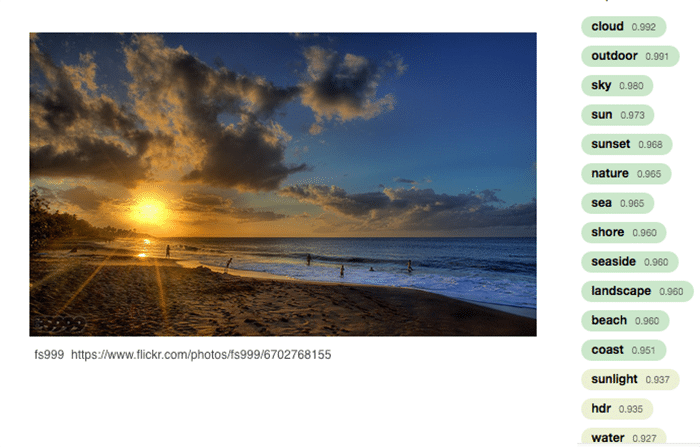 Simon can't share details about upcoming features. But he says Flickr's team is bringing more machine learning smarts to their mobile platforms, training more sophisticated models on much bigger sets of images – and using GPUs to do it. More Magic Coming"We do have some exciting new image intelligence features — beyond simple auto-tagging — that we should be rolling out later this year," he says. "And for the auto-tagging system, we are continually expanding the repertoire of concepts our models are able to handle, as well as working to improve the accuracy and coverage of the concepts that we already use." Read more about "Magic View," and other new features on Flickr's blog. Featured image (top): Paul Reynolds, via Flickr. Some rights reserved. The post Picture This: NVIDIA GPUs Sort Through Tens of Millions of Flickr Photos appeared first on The Official NVIDIA Blog.   |

| You are subscribed to email updates from The Official NVIDIA Blog To stop receiving these emails, you may unsubscribe now. | Email delivery powered by Google |
| Google Inc., 1600 Amphitheatre Parkway, Mountain View, CA 94043, United States | |