The NVIDIA Blog |  |
- Better Beer Through GPUs: How GPUs and Deep Learning Help Brewers Improve Their Suds
- The Future’s Already Here: NVIDIA SHIELD Streams Stunning Sea of Content
- This is Going to Get Messy: ‘Killing Floor 2’ Adds NVIDIA FleX
| Better Beer Through GPUs: How GPUs and Deep Learning Help Brewers Improve Their Suds Posted: 02 Sep 2015 10:00 AM PDT Jason Cohen isnʼt the first man to look for the solution to his problems at the bottom of a beer glass. But the 24-year-old entrepreneur might be the first to have found it. Cohenʼs tale would make a great episode of HBOʼs "Silicon Valley" if only his epiphany had taken place in sun-dappled Palo Alto, Calif., rather than blustery State College, Pa. That Cohen has involved GPUs in this sudsy story should surprise no one. This is the tale of a man who didnʼt master marketing to sell his product — quality control software for beer makers. He had to master it to make his product. The answer, of course, turned out to be free beer. And thatʼs put Cohen right in the middle of the fizzy business of craft brewing, a business that moves so fast heʼs enlisted GPUs to help his software keep up.  Cohenʼs no stranger to fine food. His parents, both attorneys, were connoisseurs of fine olive oil. Cohen inherited their eclectic tastes. He became a professional tea taster before moving north, from Florida, to take an undergraduate political science scholarship at Penn State. There — while bouncing around from one discipline to another — he founded Penn State's Tea Institute, now one of the worldʼs leading authorities on tea and tea culture. Four years ago, Cohen was grappling with a problem that will be familiar to any data scientist. To get meaningful insights for the institute he needed more data. And to get it, he had to beg the college students around him to slurp tea and record their impressions. Not easy. A Business Built on Free BeerThatʼs when it hit Cohen: forget tea. Heʼd build his data set by offering free beer. Volunteers packed into his tastings, scribbling down their impressions of whatever suds Cohen served them. Bitter India pale ales. Crisp pilsners. Malty, chocolatey doppelbocks. They inhaled the two- to three-ounce portions. Within weeks, Cohen had a trove of data that started yielding insights. He could use the data to identify flaws in beers. Beer that tastes like fresh-cut grass, for example, reveals too much of a compound called cis-3-hexenol. Thatʼs caused when hops used in a beer are stale. Itʼs something any brewer will want to know right away.  Better still, Cohen could tease out insights that might escape the taster. A novice drinker, for example, may not know the difference between a good beer and one that has been "skunked" — giving the beer a manure-like flavor — because of exposure to too much light. But, by analyzing a drinkerʼs impressions of a beer, Cohen can. Better yet, he could predict what demographic groups would like a beer. Thatʼs when Cohen realized he didnʼt have a research project. He had a business. Turns out 11 percent of all U.S. beer sales by volume last year came from small brewers. Better still, these fast-growing brewers are guzzling more than their share of sales, grabbing 19 percent of the beer industryʼs $101.5 billion in retail sales. An Ale of an OpportunityItʼs the culmination of a brewing renaissance that shows no signs of slowing. In 1983, there were just 51 U.S. brewers. The top six owned 92% of the market. Access to better technology is changing that. Small brewers — equipped with affordable new technologies like automated, high-quality canning systems — have been surging over the past two decades. There are now more than 3,000 of them. "Thatʼs what saved beer, new technologies," Cohen says. To swallow even more of the market, these small brewers need to be consistent. Brewers — particularly small, craft brewers — live or die by quality and consistency. But no one is immune. During the 1970s, bad-tasting beer — due to experimentation with new brewing methods — all but destroyed Schlitz, once the top-selling beer in the United States. "Thatʼs a story we tell to our clients," Cohen says. Key to consistency: speed. While Cohenʼs trove of data lets him tease out 20 common flaws in a beer with just a handful of tastings — as drinkers record impressions on 25 factors on their smart phones — results werenʼt coming in quickly. That can be trouble as brewers scramble to get beer to loading docks. Once that beer gets on the truck, Cohen explains, they donʼt own it any more.  Chugging Data FasterSo Cohenʼs 11-employee team began experimenting with GPUs, which allowed them to speed up the analysis of data gathered from tasters by threefold. And because Amazon hosts GPU-accelerated servers, the team can just rent access to the GPUs they need. Thatʼs crucial to detecting bad beer. Buttery diacetyl, for example, improves the thick, creamy body of dark porters and stouts. But itʼs a fatal flaw in a crisp lager marketed to millions. Cohen's using GPUs for more than just classifying beers. He's using them to create models that help analyze profiles generated by tasters against the more than 100,000 beer reviews his company has collected. Without the parallel architecture of GPUs, for example, it took Cohen's team a long time to train deep neural networks with many layers, or random forest models with many trees. Cohen's team now uses NVIDIA's CUDA toolkit in R — such as gputools and gmatrix — to boost performance. Now model tuning only takes minutes to complete. 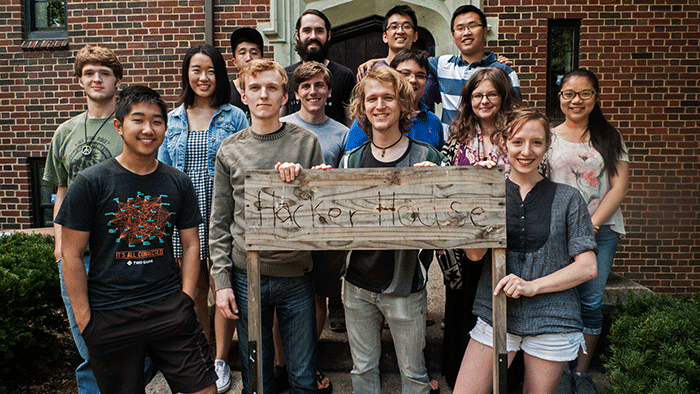 Next up: growing his business. Cohen — now CEO of Analytical Flavor Systems — has one customer whose name he can drop, Ottoʼs Pub and Brewery. Dozens more are either working with him under non-disclosure agreements, or are in the pipeline. Heʼs raising his first venture capital round. And heʼs planning to move into new offices. Itʼs an old frat house, appropriately enough. Itʼs a familiar tale for any entrepreneur, with one exception: Cohen says recruiting new employees is "really easy." After all, this is a business built on daily beer tastings. And with every chug, Cohenʼs data set grows larger. Photo credit (top):Kate Borkowski, some rights reserved.
The post Better Beer Through GPUs: How GPUs and Deep Learning Help Brewers Improve Their Suds appeared first on The Official NVIDIA Blog.    |
| The Future’s Already Here: NVIDIA SHIELD Streams Stunning Sea of Content Posted: 02 Sep 2015 08:00 AM PDT You've heard the rumors. Something new is coming Sept. 9. But the features you want in a next-gen streamer are already here. Wireless remote with voice integration? Check. Universal voice and cross-app search? Check. Ability to download games from a dedicated TV app store? Check. How about a mobile OS with a user interface optimized for TV? Been there, done that.
It’s a 4K video-streaming set-top box that doubles as a gaming console." Speculation is that this new set-top box will resemble the NVIDIA SHIELD. "[I]nstead of focusing almost exclusively on streaming video it'd be a SHIELD TV-like box that can handle gaming and other tasks suited to the big screen," wrote one outlet. We're still at the beginning of the smart TV revolution, but there's no better glimpse of what it's like than our NVIDIA SHIELD Android TV box. Powering its magic is the world's most advanced mobile processor, the Tegra X1. Everyone wants their tablet, phone and TV to respond immediately. Snappiness matters. And the Tegra X1 — with its 256-core NVIDIA GPU and 64-bit CPU — helps make SHIELD the most advanced smart TV platform ever created. As one journalist noted, "you'll never hit an Internet speed bump." Consider that SHIELD:
 You can already experience amazing gaming on SHIELD — next-gen Android games, NVIDIA GRID cloud games, and PC games with NVIDIA GameStream. SHIELD is a full-fledged media entertainment center. It's ideal for apps like Kodi (formerly known as XBMC) — a free, award-winning software media center app that allows users to enjoy TV shows, movies, pictures, music, and other digital media from local or network storage and the internet. Not Even Close Aside from the instant gratification SHIELD delivers, it'll be even more useful as new apps and games get created for Android TV. Developers are continuously adding apps to Android, which already represents 70 percent of the mobile market. Think Android — the world's largest app ecosystem, entirely open and the center of your mobile life — connected to your TV. It's the apps, games and content you love — hit shows, blockbuster movies, live sports, news and viral videos — all experienced from the comfort of your couch and accessible from the Google Play store. More than 800 apps are already available for Android TV and its flagship device, SHIELD. All in an open ecosystem that highlights individuality, even through custom launchers for your SHIELD TV box. That's why SHIELD offers you performance other media-streaming devices can't even touch. But don't take it from us. One reporter noted that "what we're looking at here is twice as fast (or more) than the best phones and tablets today …." Another wrote, "the Tegra X1-powered Shield packs some serious graphical prowess that far surpasses any mobile device we've tested thus far." Future Proof That won't change. One reviewer who benchmarked NVIDIA SHIELD found it was almost twice as fast as the iPad Air 2's A8X processor — the chip rumored to power the new Apple TV. So get ready for tomorrow, today. Order NVIDIA SHIELD at http://shield.nvidia.com/, the Google Store, Amazon and Bestbuy.com. Then load it up with great content and enjoy. The post The Future's Already Here: NVIDIA SHIELD Streams Stunning Sea of Content appeared first on The Official NVIDIA Blog.   |
| This is Going to Get Messy: ‘Killing Floor 2’ Adds NVIDIA FleX Posted: 01 Sep 2015 11:48 AM PDT This is an exciting day here at Tripwire Interactive. We've added a huge patch to the early access build of Killing Floor 2 that we're calling the "Incinerate 'N Detonate" update. With it comes a bunch of cool new content that players in our beta are raving about. In this update we've brought back two fan favorite classes: the Firebug and Demolition perks, complete with their signature weaponry, as well as two new maps, Evacuation Point and Catacombs. And now there's even more firepower at your disposal. You get dual 9mm pistols, C4 explosives, the Dragon's Breath trench gun, flamethrowers, RPG launchers, and a microwave rifle. Players who own Chivalry: Medieval Warfare can even unlock a Zweihander. You can check out the full run-down here. Blood and Guts What pairs better with over a dozen new weapons than a violent hail of blood and guts? With this update we're cranking up the enhancements of our M.E.A.T. (Massive Evisceration And Trauma) system we teased at E3 this year. NVIDIA GeForce owners are going to be able to dial the gore up to 11 with new "Gibs" and "Gibs & Fluid" settings found under NVIDIA FleX in our settings menu. When NVIDIA showed us their demo of the capabilities of FleX, we knew immediately that we could turn this new particle system technology into a bloodbath. Literally! We've always featured blood and guts in our Killing Floor games, but this time it's different. With the help of NVIDIA FleX technology, we've taken the gore to a new level. FleX arrived in our offices as a middleware, but it was much more than that. It came with tools to help us easily implement new systems, and NVIDIA lent their expertise in tweaking them as needed. With FleX we've added some fantastic effects to our game — effects that will make Killing Floor 2 stand out — and we did it with minimal effort. To start with, FleX worked pretty well as soon as we plugged it in. And NVIDIA helped turn the dials and reach our vision for the "Gibs and Fluids" setting. As a smallish developer, adding these kinds of effects can make a huge difference. And making it easy for us to use is critical. Without NVIDIA's help and FleX technology, the "Gibs & Fluids" setting would not exist in its current form. The impact FleX has had on Killing Floor 2 is stunning. Blood has volume. It pools and drips realistically, squirting from the stumps of severed limbs and busted skulls. The Zeds wade through knee-high piles of flesh and gore that interact with them and their special abilities. It's not just pretty to look at, it changes our game. We're ecstatic with the results of our work with NVIDIA FleX. We know that our players will be, too. You can grab Killing Floor 2 through Steam Early Access for under $30.  The post This is Going to Get Messy: 'Killing Floor 2' Adds NVIDIA FleX appeared first on The Official NVIDIA Blog.   |

| You are subscribed to email updates from The Official NVIDIA Blog To stop receiving these emails, you may unsubscribe now. | Email delivery powered by Google |
| Google Inc., 1600 Amphitheatre Parkway, Mountain View, CA 94043, United States | |